

Wel/wp-acome to the August edition of the CanCan Diagnostics Newsletter. In this issue, we’re taking a closer look at the science behind circulating tumor DNA (ctDNA) and featuring our Case of the Month.
VCS is coming!
If you’re coming to Veterinary Cancer Society meeting in Minneapolis, between September 24–26, 2026, please come and visit us at our booth! We are sponsoring Panel Discussionon Feline Oncology. Most importantly we will be also launching a new product to help your patients! So stay tuned and come and visit us there!
NCSU and VAKPO conference
On the Road: Dr. Maciej Parys Takes CanCan Diagnostics’ Research to the World
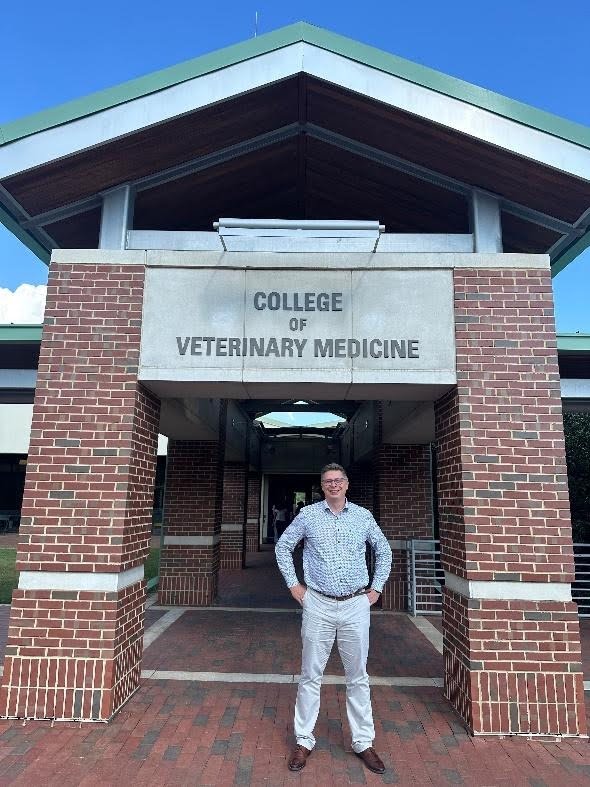
It’s been a busy few weeks of travel for CanCan Diagnostics’ CEO and Founder, Dr. Maciej Parys, as he brought the company’s research and mission to audiences across two continents.
NC State College of Veterinary Medicine, Raleigh
| Dr. Parys was invited to Raleigh to speak at NC State’s College of Veterinary Medicine, where he presented “From Bench to Bedside: A Multiomic Approach to Precision Oncology in Companion Animals.” The talk traced CanCan Diagnostics’ own origin story — from a research project into a company now delivering precision-oncology tools to veterinarians worldwide — and gave the audience a firsthand look at how multiomic approaches are reshaping cancer care for companion animals. |
VAKPO Annual Congress, Prague
CanCan Diagnostics also sponsored this year’s VAKPO Annual Congress in Prague, Czechia, themed “The Dyspneic Patient: When Breathing Becomes Hard.” Among the speakers was Dr. Barbara Kitchell, DVM, PhD, DACVIM, who introduced attendees to the growing role of sequencing and targeted therapies in treating lung cancer in pets — work that resonates closely with CanCan’s own diagnostic mission. Great conference and we are looking forward to next year’s edition!
Advancing Precision Oncology for Veterinary Teams
Across both events, the throughline was clear: CanCan Diagnostics is committed to equipping veterinary teams with advanced, accessible cancer diagnostics. Our LiquidDx™ liquid biopsy offers a minimally invasive way to detect tumour-derived DNA in the bloodstream, supporting cancer detection, monitoring of disease progression, and assessment of treatment response. For patients with a confirmed tumour, K9-TMB/MSI™ delivers comprehensive genomic profiling across 499 cancer-related genes — including Tumour Mutational Burden (TMB) and Microsatellite Instability (MSI) — to help guide precision treatment decisions.
From the lecture hall to the conference floor, these engagements reflect what drives CanCan Diagnostics every day: turning rigorous research into practical tools that help veterinarians give their patients better, more personalized cancer care.
Behind the Science: What is Circulating Tumour DNA (ctDNA)?
Did you know that tumours continuously release tiny fragments of their DNA into the bloodstream? These fragments, known as circulating tumour DNA (ctDNA), carry the same genetic alterations found within the tumour itself and can provide valuable insights into a patient’s cancer without the need for an invasive tissue biopsy.
By analysing ctDNA from a simple blood sample, veterinarians can gain important information about the presence of cancer, monitor how a patient is responding to treatment and detect signs of disease progression or recurrence over time. Because ctDNA reflects the molecular characteristics of the tumour, it offers a real-time snapshot of the cancer as it evolves.
At CanCan Diagnostics, our LiquidDx™ liquid biopsy test harnesses this innovative technology to detect and analyse ctDNA in dogs with cancer. As veterinary oncology continues to move towards precision medicine, liquid biopsy is becoming an increasingly valuable tool for supporting earlier detection, personalised treatment decisions, and ongoing disease monitoring—all through a minimally invasive blood sample.
By looking beyond what can be seen on imaging alone, ctDNA analysis provides clinicians with another powerful tool to better understand and manage cancer throughout a patient’s journey.
Case of the month
Should We Always Sequence the Tumour When Monitoring with Liquid Biopsy?
It’s a question we’re asked often. For the majority of patients we monitor, the answer is no: our liquid biopsy monitoring is tumour-agnostic. That means we don’t need a separate tumour sample to interpret the result — detecting a sufficient number of mutations and copy number alterations (CNAs) in the blood is enough to tell whether a tumour is responding to treatment or not. The thresholds behind that call aren’t arbitrary; they were established scientifically, validated across our first cohorts of patients.
That said, most human cfDNA (cell-free DNA) monitoring is done with a matched tumour sample sequenced alongside the liquid biopsy. Matching to the tumour increases test sensitivity, because it lets us search the blood specifically for the patient’s own tumour-derived variants rather than relying on general detection thresholds. The case below shows why that extra sensitivity can matter.
Case example: mediastinal T-cell lymphoma in a Rhodesian Ridgeback
A 5-year-old Rhodesian Ridgeback was diagnosed with mediastinal T-cell lymphoma. Because chemotherapy had already started by the time genomic testing was requested, the baseline mutational profile was established retrospectively from previously collected cytology slides. Profiling revealed a wide range of alterations: an activating mutation in EGFR, amplification of PDGFRA, KIT, KDR and ERBB2, and loss of PTEN and CDKN2A.
The patient was treated with the CHOP protocol. At first remission (after the second round of CHOP), liquid biopsy still showed residual disease: loss of PTEN, amplification of ERBB2 and PDGFRA/B, and three mutations matching those found in the original tumour.
A month later, a further sample was collected. Under our standard tumour-agnostic filters, only a single mutation and a single CNA were detected — alongside a higher concentration of cfDNA. Taken at face value, the falling mutation count would suggest near-complete molecular remission. But the rising cfDNA concentration didn’t fit that picture — an increase like this is unusual in genuine remission, and it was concerning enough to prompt a closer look.
Going back and re-examining the variants that had been filtered out under standard tumour-agnostic thresholds, we found two MITF variants shared between the original tumour and the current cfDNA sample — variants that would otherwise have been dismissed as background noise. This is a clear example of how joint calling of tumour and cfDNA together can rescue genuine, low-level disease signal that a tumour-agnostic filter alone would have missed — avoiding a false impression of remission.
The next sample confirmed the concern: a high-frequency SETD2 variant (p.C1752Vfs*14, at 10.42% variant allele fraction) emerged, matching a variant previously identified in the original tumour. Treatment was switched from CHOP to LOPP. A subsequent sample showed the SETD2 variant persisting at a slightly lower frequency (8.92%), now with an additional loss of CDKN2A/B. The patient went on to become clinically progressive, and the owner elected euthanasia.
The takeaway
Tumour-agnostic monitoring remains the right, well-validated approach for most of the patients we follow. But this case illustrates exactly why matched tumour sequencing is worth considering in select cases: it caught genuine residual disease that would otherwise have looked like a false remission, weeks before it became clinically obvious.
Thank you to Dr Quentin Fournier of Lumbry Park Veterinary Specialists for sharing this case